


This article is written by Kairavi Mishra, a Second-Year B.A. LL.B. student at CMP Degree College, University of Allahabad.


Traditional criminal law treated victims as mere witnesses but , with BNSS 2023 giving them voice are we finally doing justice to the victims ?
“We have only been referring to accused-centric jurisprudence in criminal law. The victims have always been pushed into a corner. Unfortunately, we have never thought of victims.”[1]— Chief justice of India SURYA KANT
The traditional criminal justice system has largely operated on an offender – centric model ,prioritizing prosecution and punishment while relegating victims to a peripheral and passive role which means to sideline them or diminish their importance and active involvement in their own narrative. Contemporary criminal law however , is witnessing a significant shift towards victim – centric model of justice which seeks to recognise the rights , dignity, and needs of victims alongside the rights of the accused.
This shift reflects the growing recognition that justice cannot be considered complete merely by punishing the offender; it must also address the harm suffered by the victim. In the traditionalframework the victims had limited participation in criminal proceedings ,emotional,psychological and financial losses suffered by victims are often overlooked, delays in proceedings may prolong victims’ trauma .
Emergence of discussions on victims rights and victim centric justice in world
It started when global victims’ rights movement[2]gained momentum with the adoption of the United Nations Declaration of Basic Principles of Justice for Victims of Crime and abuse of power (1985).The declaration emphasized access to justice ,fair treatment, restitution , compensation and assistance for victims
Emergence of victims rights and victim centric justice in India
It started with the growth of victimology[3] during the twentieth century as it highlighted the need to protect victims interests, compensation and ensure participation in criminal proceedings ,
Different committees have also played significant role in bringing reforms towards victim – centric justice in India :-
- Madhav Menon Committee (2003) – Committee on Draft National Policy on Criminal Justice
• Objective: To revamp the criminal justice system to make it more responsive and efficient.
• Victim-Focused Recommendations: Suggested creation of a Victim Compensation Fund. Emphasized restorative justice and rehabilitation over mere punishment. Called for victim participation in proceedings, including being heard during sentencing. Highlighted the need for support services like counseling, shelter, and legal aid.
- Malimath Committee (2000–2003) – Committee on Reforms of Criminal Justice System • Chairperson: Justice V.S. Malimath
• Key Recommendations: o Victims should have a right to be heard during the trial andsentencing Introduction of a Victim Advocate intrials to represent the interests of the victim. o Creation of a Comprehensive Victim Compensation Scheme. Restitution and rehabilitation must be made part of sentencing policy. • Significance: Laid the foundation for victim-centric provisions in BNS and BNSS .
- Justice Verma Committee (2013) – Post Nirbhaya Incident
• Purpose: To suggest amendments to criminal law for ensuring the safety of women.
• Victim-Centric Focus: Emphasized speedy justice and dignity of rape victims. Recommended emergency response, rehabilitation, and counseling support. Called for fast-track courts for crimes against women. Stressed police sensitivity training in handling victims.
.
Indian courts increasingly emphasised victims rights through various judgements for example in
1.DELHI DOMESTIC WORKING WOMEN’S FORUM V.UNION OF INDIA (1995)[4] the court emphasised compensation ,legal aid ,and support for rape victims ,
2.inLAXMI V. UNION OF INDIA (2014)[5],rehabilitation, free medical treatment and compensation for acid attack victims were provided
3. also in case ofANKUSH SHIVAJI GAIKWAD V. STATE OF MAHARASHTRA (2013)[6] , a landmark judgement made victim compensation under sections 357 and 357A of Crpc a mandatory consideration .
The acts like bhartiya nyaya sanhita (2023), that replaced IPC and Bhartiya nyaya suraksha sanhita (2023) that replaced Crpc are tend to change the traditional framework of indian criminal law as they now seek to improve victims’ rights ,protection ,and their involvement in criminal justice system .
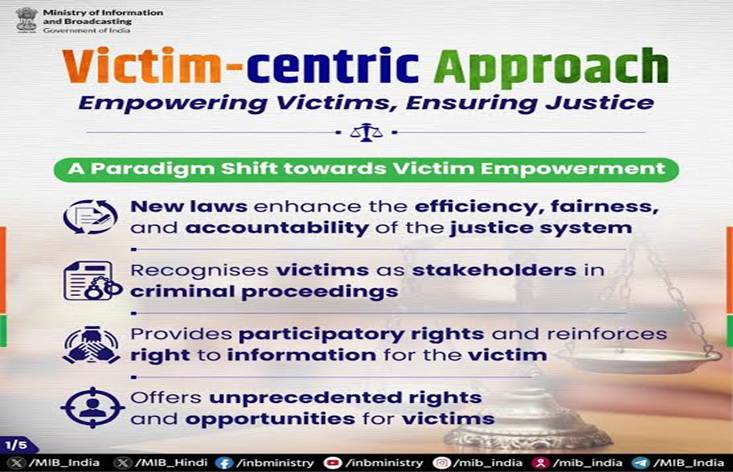
Some victim centric provisions under BNSS (2023) are as follows [7]:
1.Zero FIR and easier FIR registration [8]
Under this FIR can be registered at any police station regardless of jurisdiction and refusal is restricted .This ensures that victims no longer forced to run from one police station to another also this reduces delay in starting criminal investigation
2. Mandatory FIR copy to victims
Victims must be given a FIR copy free of cost this will ensure their participation in the legal process
3.Progress update to victims
Victims are entitled to get update on progress of their case within 90 days . This provision keeps victims informed and involved in legal process , enhancing transparency and trust .
4.Witness protection scheme
The new laws mandate all atate governments to implement witness protection scheme to ensure safety and securityof witnesses , enhancing the credibility and effectiveness of legal proceedings.
5.Victims right to be heard
It is mandated that victim be heard before withdrawal from prosecution in Section 360 of BNSS. The statutory recognition of the right of the victim to be heard is a significant example of a nyaya centric approach to criminal justice system. By mandatorily hearing the victim in proceedings regarding withdrawal of cases, the justice system becomes more responsive to the needs and concerns of those directly affected by crime.
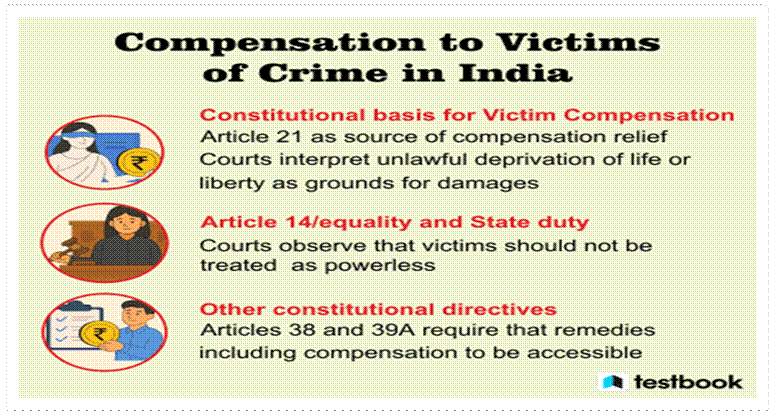
In India constitutional guarantees under article 14 and 21 have increasingly been interpreted to include victims’ rights. Judicial activism and legislative reforms have gradually transformed the criminal justice system from being solely accused centric to one that acknowledges the rights and interest of victims .
Need of victim centric laws ?
Victim centric laws are needed because victims often suffer beyond the initial crime. They face physical injury,emotional trauma, financial loss , and sometimes social stigma . Without legal support many victims feel ignored by justice system which can discourage them from reporting crimes or cooperating with investigations.
Why equal focus on both accuse and victim and why not just on accuse ?
because justice is incomplete without victim recovery, true justice should also aim to restore the victims’ physical ,emotional and financial well being .Also to create and ensure balance in criminal justice system as focusing only on accuse can create imbalance and ignoring victims undermines the moral foundation of justice .A fair system should protect both the sides
To strengthen trust in legal system and for proper rehabilitation of the victims it is necessary and essential to have more victim centric laws and these laws should be victim friendly and have easy process to ensure that victims file more reports of crime and not refuse to file report due to shame ,fear , or less trust on system
ANCIENT INDIAN TRADITION : VICTIM CENTERED JUSTICE
In ancient India as reflected in text like manusmriti , Arthashastra and Dharmashastra , the concept of justice was deeply interwined with moral duty (dharma) and social harmony . The victims played a significant role in the process of dispute resolution .Compensation , reconcilliation , and restorative elements such as the return of stolen goods or public apologies were emphasized alongside punishment . The focus was often on restoring balance rather than purely penalizing the wrong doer , indicating an early form of victim recognition and community based justice .
This shows that even the ancient laws and scripts of india promoted more victim centric justice but then how it changed completely into a accussed or offender centric justice ?the answer for this is the colonial period Britishers made a lot of new laws that completely changed the ancient way of providing justice , they introduced IPC (1860) and Crpc (1898) and these laws institutionalized an offender – centric approach . The victim’s role was reduced to that of a mere witness , with little or no procedural rights once FIR was filed .
Even after independence there was slow recognition of victims needs despite of growing awareness in international legal system but gradually after decades due to arrival of new reform under BNSS 2023 the emergence of victimology in Indian law system it reinforces the idea that justice must serve all parties to the conflict not just the state and the offender, but also the victim .
Challenges to the Victim-Centric Approach under BNSS, 2023
1. Implementation Gap
Although BNSS grants victims more rights, the success of these provisions depends on police, prosecutors, courts, and legal aid authorities. Inadequate infrastructure, lack of trained personnel, and weak enforcement mechanisms may prevent victims from actually benefiting from these rights.
2. Limited Awareness Among Victims
Many victims, particularly in rural and marginalized communities, are unaware of their procedural rights such as receiving case updates, claiming compensation, or participating in proceedings. Without effective legal literacy programs, these rights may remain largely theoretical.
3. Procedural Delays
Despite time-bound provisions in BNSS, delays in investigation and trial continue to be a major concern. Prolonged proceedings can cause secondary victimization, emotional stress, and loss of faith in the justice system.
4. Inadequate Compensation Mechanisms
Victim compensation schemes often suffer from bureaucratic delays, inconsistent implementation across states, and difficulties in assessing compensation amounts. As a result, victims may not receive timely financial relief.
5. Limited Victim Participation
Although BNSS increases victim involvement, victims still have a relatively restricted role in critical decisions such as plea bargaining, prosecution strategy, and sentencing. The criminal process largely remains state-controlled.
6. Insufficient Support Services
A truly victim-centric system requires psychological counselling, rehabilitation services, shelter homes, and witness support. BNSS focuses mainly on procedural rights and compensation but does not comprehensively address these support mechanisms.
7. Balancing Victims’ Rights and Accused’s Rights
Criminal justice must balance victim empowerment with the constitutional rights of the accused, including fair trial and due process. Excessive emphasis on victim interests may create concerns regarding the presumption of innocence and procedural fairness.
8. Witness Protection Concerns
Victims often face intimidation, threats, or social pressure, especially in serious crimes. Effective witness and victim protection mechanisms remain a challenge despite legislative
CONCLUSION
An important paradigm shift from an offender-oriented criminal justice system to one that protects the rights, dignity, and well-being of victims is reflected in the development of victimcentric justice in India. Many of these long-standing recommendations have been addressed by legislation with the enactment of the Bharatiya Nyaya Sanhita (BNS), 2023, and the Bharatiya Nagarik Suraksha Sanhita (BNSS), 2023. The essential spirit of the committee’s recommendations is reflected in these new codes, which include restorative justice, improved procedural safeguards, compensation systems, and larger victim definitions. But how well these improvements are implemented will be their real test. The idea of a truly victim-centric legal system will remain aspirational in the absence of sufficient institutional support, professionally trained staff, and victim-sensitive protocols. Therefore, to guarantee that victims are not merely passive witnesses but active participants in the administration of justice, ongoing judicial scrutiny, ongoing policy evaluation, and a dedication to human dignity.
REFERENCE
1.REPOSITIONING THE VICTIM: A CRITICAL ANALYSIS OF VICTIM CENTRIC JUSTICE IN INDIAhttps://ijlr.iledu.in/wp-content/uploads/2025/07/V5I1156.pdf
2.VICTIM-CENTRIC JUSTICE UNDER BNS AND BNSS: AN EVOLVING PARADIGM IN INDIAN CRIMINAL LAW https://www.ijllr.com/post/a-critical-study-on-the-advantages and-challenges-in-implementing-the-three-new-indian-criminal-laws-1
[1] Speaking on May 21, 2026, during a Chit Fund Scam case, emphasizing that the convenience of the accused cannot outweigh the financial devastation of poor victims). [1]
[2] The global victims’ rights movement formally began in 1975 and achieved worldwide recognition with the 1985 UN Declaration, shifting the legal focus from solely punishing offenders to providing systemic justice, support, and recognition for crime victims.
[3] Victimology is the scientific study of crime victims, focusing on why certain people are targeted, how the justice system treats them, and the psychological and financial impacts of victimization
[4] Delhi Domestic Working Women’s Forum v. Union of India, (1995) 1 SCC 14 (SC)
[5] Laxmi v. Union of India, (2014) 4 SCC 427 (SC)
[6] Ankush Shivaji Gaikwad v. State of Maharashtra, (2013) 6 SCC 770 (SC)
[7] SOURCE FROM https://www.mha.gov.in/MHA1/Par2017/pdfs/par2025-pdfs/RS17122025/1989.pdf
[8] Zero FIR: Section 173(1) of BNSS explicitly states that information regarding a cognizable offence can be given to the police “irrespective of the area where the offence is committed.”
