

This article is written by Kirtika Singh, a third-year B.A. LL.B. student at Prof. Rajendra Singh (Rajju Bhaiya) University, Naini, Prayagraj.
- Introduction
Indian Legal Framework is adopting a techno-legal paradigm under section 105 of BNSS, by integrating technology to enhance crime scene assessment but it’s asking the wrong device to do the right job.
Section 105 of BNSS, 2023 makes the video recording of the search and seizure process mandatory to increase the credibility of the investigative process. However, the “right job” of recording the entire process and eventually uploading it is done by the definitive means of the officer’s personal mobile devices. This setup poses a significant problem as the outcome of any criminal cases is not solely decided by trial as long before the case reaches court the investigative process of how the search was conducted, how recovery is filmed and how witnesses are handled in the beginning shapes the entire judgment. This provision came to secure this vulnerable stage by tracking the process via video so that the entire judicial process becomes easier as less dispute over what happened during a raid is not decided by relying on memories and unverified claims. The underlying issue of this provision is that it tries to fix one weak link of the process by creating another by letting the officer record in their private phone poses a significant threat to its integrity as evidence.
Essentially, the courts are concerned due to lack of technical distinction even under section 105 of BNSS. As seen in the case of Shadab v. State of U.P. courts are now granting bail showing that when police fail to properly record a seizure, it ruins the credibility of their case from start. This forces court to settle procedural disputes that the statute was explicitly written to prevent.
This article assesses how the absence of more standardized with encrypted recording equipment and state-controlled infrastructure rather than personal property has converted the earliest point of safeguard to earliest point of failure.
II. Section 105 BNSS and e-sakshya: the mandate vs. reality
BNSS 2023 introduced a foundational shift in Indian criminal justice system regarding the Conduct of search or seizure of any property. For cognizable offences, section 105 of BNSS replaces Section 93 of CrPC with more strict and clear instruction by employing the word “shall,” leaving no room for administrative ambiguity. it mandates the entire process—including writing down the seizure list and getting witnesses to sign it— to be recorded using audio-video electronic means like mobile phone¹ and further require the video to be immediately be sent to local Magistrate. Similarly, section 185 of BNSS displaces section 165 of CrPC for non cognizable offences having exact same recording rule. These sections when read together with section 63 of BSA, 2023 which recognises authentic data and systematically reliable electronic records as admissible evidence clearly indicate a legal chain which specify that officers have to record the scene, send it quickly to authorities and admit it reliably. This mandate is further tightened in states like Uttar Pradesh where Rules 18(1) and 18(2) of the Uttar Pradesh BNSS, seek to strictly enforce accountability during police raids by adding the video to the case diary and sending to the magistrate within 48 hours through the e-Sakshya system. In theory, a time-stamped, securely uploaded video fixes an old weakness of any later arguments in court about what actually happened during a police raid.
In reality, however the provision of section 105 of BNSS fail to specify whether officer are supposed to use their own devices or official phone on top of it the state failed to provide standardized, state-issued, and encrypted recording hardware leaving officer no choice but to download e-Sakshya application and record it in their mobile phone where the evidence may suffer many in-built problem like low battery and full storage and its credibility becomes uncertain as personal devices data due to being connected to internet are susceptible to alteration.As a result, the critical first link in the chain breaks before the evidence ever reaches the standards required by Section 63 of the BSA, Rule 18 of the UP Rules, or judicial review.
III. The compounded harm: chain of custody and privacy
The structural reliance of letting officer use their private property for investigative videos evidence does not merely create a practical inconvenience but also subsequently trigger dual legal failures. It simultaneously shatters the digital chain of custody under section 63 of BSA and threatening citizen’s right to privacy under Article 21.
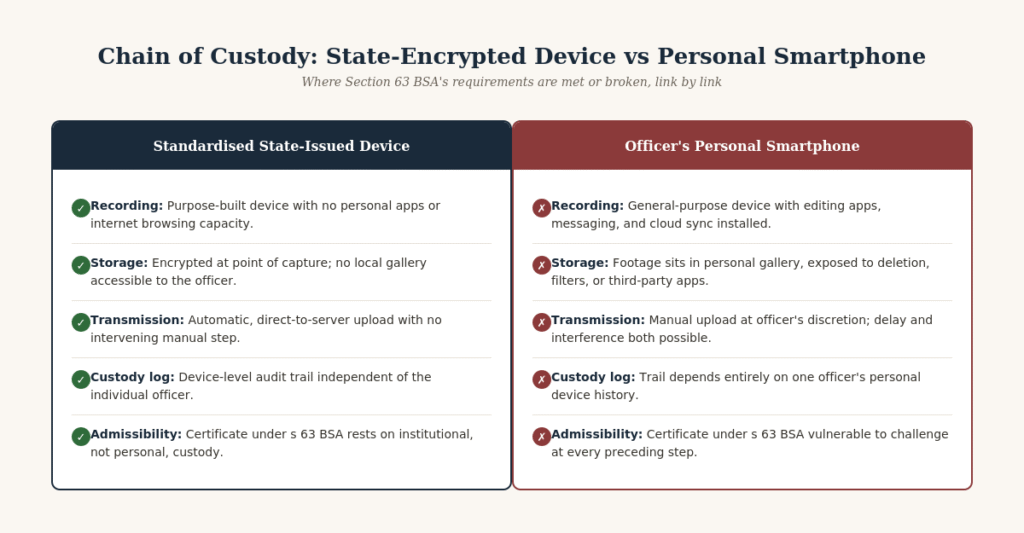
The conditions the admissibility of electronic records under section 63 of BSA requires strict authentication of their systemic integrity and routine operation. This standard is hard to meet while using personal smartphones because these consumer phone continuously connected to internet and runs on commercial software that allow users to edit, crop, or delete files locally within seconds, compromising the digital records chain of custody from the start. In court, the defence can easily challenge it and defence would have no way of proving that the footage not was selectively paused or modified, before uploading them. Additionally, the phone is private property filled with personal data which makes it nearly impossible to issue a clean electronic certificate under Section 63.
This evidentiary failure directly translates into constitutional violation of the right to privacy. Under three-part test laid down by Supreme Court in K.S. Puttaswamy’s case Section 105 of the BNSS successfully satisfy the legality claim and have legitimate aim of ensuring transparent investigations but it fails to fulfil the proportionality test as it demands the state interference with privacy to be least intrusive and include strict safeguards against abuse. Currently, the raw footage of crime scene are simply left in possession of a private device without any protocols, those footage often captures peoples intimate spaces like house interior, identities of minors and uninvolved third parties that have legal right to remain private. The lack of official encryption on personal smartphones there is always a risk of data leak by means malware, accidental cloud backups, or unauthorised civilian access.
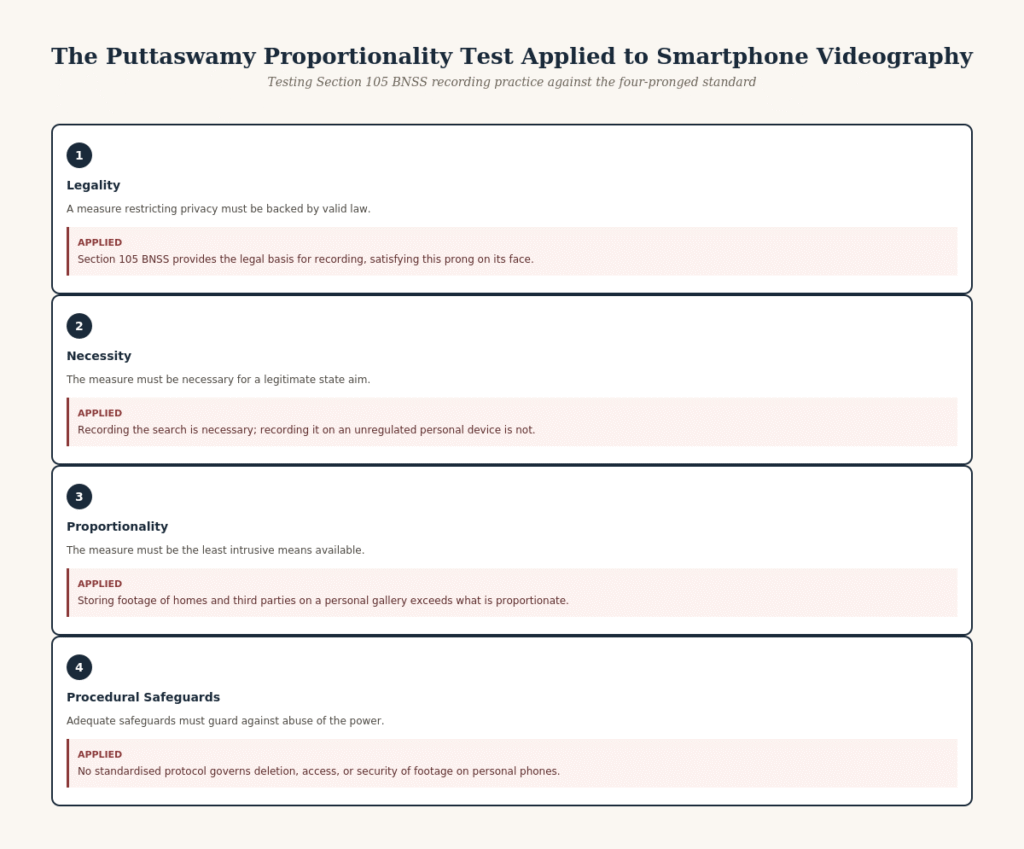
Ultimately, the execution of the law exposes the simple aim of documenting a police search to unregulated invasion of privacy, turning this legal shield into a constitutional risk.
IV. Judicial response — shadab v. State of u.p.
The clash between the strict new laws and how every police works were exposed in Allahabad High Court in Shadab v. State of U.P. (2026). This case perfectly illustrated the operational flaws with police department on ground due to structural gap; the prosecution claimed that during a raid they found forty stolen motorcycles in an open field which were directly linked to the accused. However, despite this massive claim the police completely failed to perform their legal duties under section 105 of BNSS, they did not record the search, skipped the mandatory e-Sakshya upload entirely and they also failed to secure any independent witness to verify their claims.
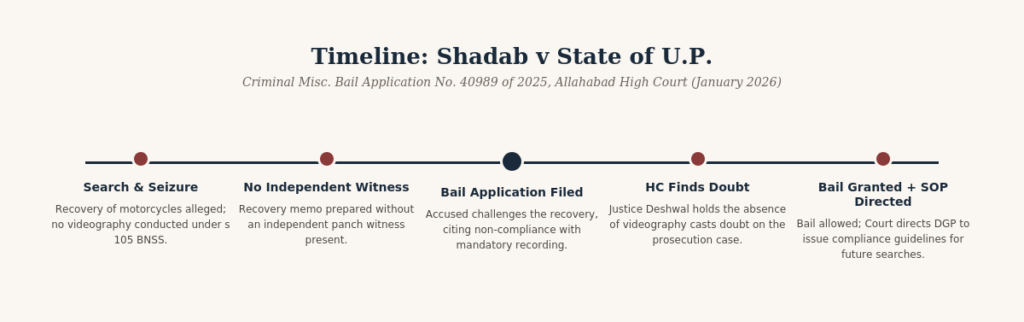
Justice Deshwal, adopting a strict approach in his ruling made it clear that following new legal rules is non-negotiable as this law was rightfully modified from old CrPC to BNSS to ensure transparency and eliminate any arbitrarily action by police. As a result, the High Court granted bail to the accused, establishing a clear judicial precedent that digital non-compliance shall not be ignored.
The High Court recognized that this failure happens because due to lack proper equipment provided by state to police departments not because officers were simply negligent. To remedy this court ordered the Director General of Police (DGP) of Uttar Pradesh to create a clear Standard Operating Procedure (SOP) to enforce Section 105 across every district.
Crucially, the Shadab ruling exposes the impossible trap faced by investigating officers on a daily basis. The legal loop restrains them from recording the scene in their private phone as it is violative of section 63 of BSA and people fundamental right to privacy; at the same time they lack instrument to rightfully capture the scene which is necessary to ease the judicial process as mandated by Shadab’s ruling otherwise they may face immediate disciplinary action from their own department.
By penalizing officer after not providing them proper tools, the judiciary sends a clear warning to the government that unavailability of official, secure police equipment will continue to damage criminal cases and cause them to fall apart at the very first stage of trial.
V. Bridging the Practicality Gap: Systemic Reform
The “practicality gap” exposed by Section 105 of the BNSS and the ruling in Shadab cannot be resolved by simply punishing field officers. To protect constitutional rights while simultaneously preventing the collapse of criminal cases, the state has to stop relying on use of personal smartphones and instead introduce a secure institutional framework.
This requires a two-fold structural intervention:
- Procurement of Dedicated, Hardware-Locked Devices: The government must supply every police station with official, department-issued recording tools to fix the infrastructure gap. These devices need customized software so that it cannot be accessed by Smartphone features like normal web browsers, social media apps, or private cloud storage. They must be designed to use e-Sakshya application, and all the other setting and features allowing officer to pause, edit, or delete any recorded footage should be blocked.
- Automated, Zero-Trust Data Architecture: The police department needs data systems that prevent video files from saving to personal storage. Those footages shall directly be uploaded to a secured government-controlled server, to maintain admissibility of those footages as evidence under section 63 of BSA, a digital log tracking the video’s metadata, including time and location stamps must be kept which would prove that footage captured were untampered.
Section VI: Conclusion
Ultimately, Section 105 of the BNSS is a major step toward a modern and transparent criminal justice system, but it cannot work if the state lacks the right infrastructure at ground level. The state must simply not treat these tools as optional or recommend an unsecure alternative because its ruins the standard of investigation, ultimately, breaking peoples trust.
Making officers use personal devices just create an illusion of modernization, when it just replaces unverified police statements while adding brand-new problems involving leaked privacy and ruined evidence. Legal reform will only happen when the government finally provides the official tools needed to make its own laws actually work on the ground
References
1 Bharatiya Nagarik Suraksha Sanhita 2023, s 105.
2 ibid.
3 Shadab v State of UP, Criminal Misc. Bail Application No. 40989 of 2025, 2026 SCC OnLine All 5
(Allahabad HC, 5 January 2026).
4 Dr. Amit Kumar Bagaria, ‘Cybercrime Prosecution Gaps under IT Act and New Codes in India’ (2025) 14(12)
International Journal of Humanities and Social Science Invention (IJHSSI) 49, 50-52
http://www.ijhssi.org/papers/vol14(12)/14124955.pdf.
5 Bharatiya Nagarik Suraksha Sanhita 2023, s 105.
6 Code of Criminal Procedure 1973, s 93 (repealed).
7 Bharatiya Nagarik Suraksha Sanhita 2023, s 185.
8 Code of Criminal Procedure 1973, s 165 (repealed).
9 Bharatiya Sakshya Adhiniyam 2023, s 63.
10 Uttar Pradesh Bharatiya Nagarik Suraksha Rules 2024, r 18(1)-(2).
11 Legal Service India, ‘Audio Video Recording of the Search and Seizure Operation: Sections 105/185 of the
BNSS 2023 and its Limitations’.
12 Bharatiya Sakshya Adhiniyam 2023, s 63.
13 Constitution of India 1950, art 21.
14 BSA 2023, s 63.
15 Legal Service India, ‘Audio Video Recording of the Search and Seizure Operation: Sections 105/185 of the
BNSS 2023 and its Limitations’.
16 K.S. Puttaswamy v Union of India (2017) 10 SCC 1.
17 ibid (Chandrachud J).
18 Shadab v State of UP, Criminal Misc. Bail Application No. 40989 of 2025, 2026 SCC OnLine All 5
(Allahabad HC, 5 January 2026).
19 ibid.
20 ibid.
21 ibid.
22 ibid.
23 ibid.
24 Bharatiya Sakshya Adhiniyam 2023, s 63; Constitution of India 1950, art 21.
25 Shadab v State of UP, Criminal Misc. Bail Application No. 40989 of 2025, 2026 SCC OnLine All 5
(Allahabad HC, 5 January 2026).
26 Bharatiya Nagarik Suraksha Sanhita 2023, s 105.
27 Shadab v State of UP, Criminal Misc. Bail Application No. 40989 of 2025, 2026 SCC OnLine All 5
(Allahabad HC, 5 January 2026).
28 Uttar Pradesh Bharatiya Nagarik Suraksha Rules 2024, r 18.
29 Bharatiya Sakshya Adhiniyam 2023, s 63.
30 BNSS 2023, s 105.
31 Shadab (n 2).
