

This article is written by Dipanshu Verma, a second-year undergraduate law student at Prof. Rajendra Singh (Rajju Bhaiya) University, Prayagraj.
“What is meant by the Right to Privacy”:—
Right to life and personal liberty includes Right to Privacy as an integral part guaranteed under part III of the Constitution;Justice K.S. Puttaswamy (Retd.) v. Union of India,AIR 2017 SC 4161.
Right to Privacy is an integral part of life.This is a cherished constitutional value,and it is important that human beings be allowed domains of freedom that are free of public scrutiny unless they act in an unlawful manner;Ram Jethmalani v. Union of India,(2011) 8 SCC 1: JT 2011 (7) SC 104: (2011) 6 SCALE 691.1
The right to privacy is the right of an individual to control the dissemination and use of personal information, maintain personal autonomy, and protect one’s dignity. It encompasses the right to make personal decisions without interference, safeguard personal data, and enjoy private spaces free from surveillance. Recognized as an essential facet of personal liberty and dignity, this right has gained constitutional status in both India and Germany through landmark judicial interpretations and protections.
“Human rights law”:—
Human rights are the rights that we possess as human beings–right to live, liberty and human dignity.Protection of human rights, indicated by the Human Rights Index is a measure of a country’s status or level of development.Protection of human rights is of prime importance because they are the basic rights to be enjoyed by every human being.
The issues relating to human rights’ violations not only pertain to humans in general but also specific vulnerable sections like women, children, bounded labourers, persons with disability and refugees.
The violation of human rights can be studied in two different perspectives,i.e. during normal circumstances,and during special situations like war.Under normal circumstances the human rights remain,more or less,secure and there are little violations.The citizens have the right to criminal justice and freedom from arbitrary detention and punishment.2
“Fundamental Right or Legal Right?”:—
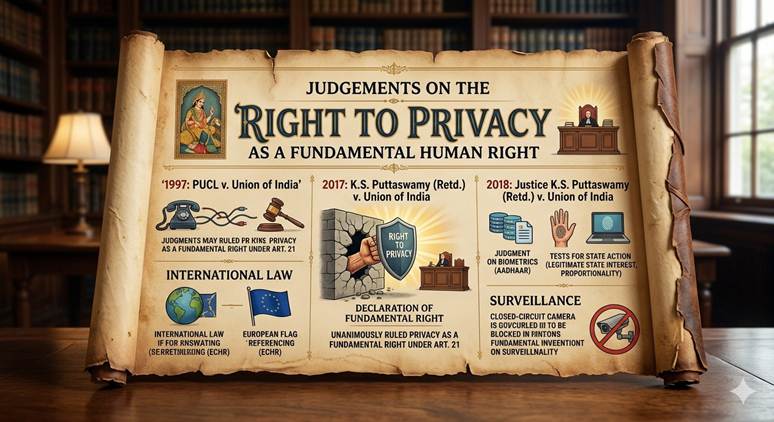
Justice K.S. Puttaswamy v Union of India;The Supreme Court held that a fundamental right to privacy is guaranteed under the Constitution of India.
“Explanation of citations and reference of Case Law”:–
- Justice K.S.Puttaswamy(Retd) And Anr. vs Union Of India And Ors. on 24 August, 2017.
- Supreme Court Cases (SCC) Citation: (2017) 10 SCC 1
- All India Reporter (AIR) Citation: AIR 2017 SC 4161
- Writ Petition Number: Writ Petition (Civil) No. 494 of 2012.
- The Supreme Court handed down a major ruling: privacy is a protected right. It’s an essential part of Article 21 and baked into the freedoms we’re guaranteed by Part III of the Constitution. A nine-judge panel made that call.
- Then there’s ‘Aadhaar,’ brought in as an identification card to identify individuals. The group in charge of issuing the card and signing people up is the Unique Identification Authority of India (UIDAI), set up back in 2009.
- The whole point of the Unique Identification Scheme (UIS) was to give everyone a one-of-a-kind ID number, making sure no two numbers were ever the same. So far, UIDAI has signed up almost 1.1 billion people in India. But some folks didn’t like the Aadhaar project. Justice K.S. Puttaswamy, who’s retired, and Mr. Pravesh Khanna actually filed a court case. This challenge came about when the Aadhaar scheme didn’t even have a law behind it yet.
- The challenge argued it violates basic rights for tons of citizens in India, including the right to privacy protected under Article 21 of the Constitution.
- When lawmakers passed the Aadhaar Act in 2016, a bunch of people filed lawsuits against it. All the cases from petitioners with the same goal got combined.
- So, the main question is whether the Aadhaar Act messes with the right to privacy and if it’s constitutional.
- What level of protection is needed for the collection, storage, and use of biometric data? Does the Aadhaar Project create or risk creating a surveillance state and is it unconstitutional on that basis?
- Observation:A nine-judge Bench of the Supreme Court unanimously declared that privacy is a constitutionally protected right. It is part of liberty, dignity, and individual choice. The Supreme Court ruled that the right to privacy is fundamental. This right shields a person’s private life from interference by both state and non-state actors and allows individuals to make their own life choices.
- The right to privacy connects to fundamental rights found in Articles 14, 19, and 21 of the Constitution of India. The fundamental right to privacy includes at least three aspects: intrusion into a person’s physical body, informational privacy, and privacy of choice.
- The Supreme Court emphasized that privacy allows individuals to control their own personalities. The Court firmly stated that privacy has always been a natural right, granting individuals the freedom to have control over their personalities. Privacy is also recognized as a natural right that belongs to individuals and cannot be taken away.
- Additionally, the judgment states that, regarding Article 21, when reviewing a specific provision, one must apply the ‘just, fair, and reasonable test,’ incorporating the idea of proportionality.
- The Aadhaar Act establishes a database containing the biometric and demographic information of all Indian residents and citizens. This information can impact every aspect of a person’s personal, professional, religious, and social life. Such power poses a threat to individual freedoms.
The Supreme Court overruled the decisions in M P Sharma v Satish Chandra, District Magistrate, Delhi (1954) and Kharak Singh v. State of U.P. & Ors (1963) in this case.
Advantages
- Protects Personal Autonomy: Safeguards intimate details of an individual’s life, including personal beliefs, medical history, and sexual orientation, allowing for free self-expression.
- Prevents Government Overreach: Acts as a bulwark against mass surveillance, ensuring that citizens cannot be unfairly targeted or oppressed by state authorities.
- Fosters Free Speech: Allows people to explore ideas, associate with groups, and speak freely without the chilling effect of being constantly monitored or judged.
- Ensures Data Security: Protects individuals from identity theft, financial fraud, and corporate exploitation of personal habits or biometric data.
Disadvantages
- Hinders Law Enforcement: End-to-end encryption and strict privacy laws can impede intelligence agencies and police from tracking terrorists, cybercriminals, and other malicious actors.
- Complicates Public Health: Can restrict contact tracing and the monitoring of disease outbreaks, potentially threatening broader community safety.
- Limits Corporate Accountability: Extreme corporate data shielding can make it difficult to investigate consumer fraud, algorithmic bias, or illicit online marketplaces.
- Creates Legal Bottlenecks: Balancing the boundaries of privacy against public transparency laws (like the Right to Information) often leads to complex, time-consuming legal disputes.
“Recognition of “Right to Privacy as a Fundamental Human Rights Law” under Indian legal system.”:—
In India the Right to Privacy is not expressly contained under any provision of the constitution, since 1960s, the Indian judiciary, has dealt with the issue of privacy, and recognized it under the thread of being both a fundamental right under the Constitution as well as a common law right, but at the same time refrained from defining it in iron-clad terms, the Courts have preferred to have it evolve on a case by case basis, instead, and on that basis only the right has evolved.
The first time rose in the case of Kharak Singh v State of Uttar Pradesh,in this case the domiciliary visits of police officers was contended to be unconstitutional and against Article 21, the court observed that “It is true our Constitution does not expressly declare a right to privacy as a fundamental right, but the said right is an essential ingredient of personal liberty.” Marking it as an early recognition of privacy as a fundamental right, The same question was raised once again in Govind v State of Madhya Pradesh, but the court here favored the right to privacy, and the sole restriction was placed on the basis of compelling Public Interest.
The issue of balancing the right to privacy and right to speech came in front of Supreme Court in case of R. Rajagopal v. State of Tamil Nadu, or as it popularly known as Auto Shankar case, the Supreme Court recognized the right and said, The right to privacy is implicit in the right to life and liberty guaranteed to the citizens of this country by Article 21. It is a “right to be let alone”.
Mr. X v Hospital’Z’,was another landmark case where the court said that though the alleged hospital violated the right to privacy of the person but the same was for well being and health of person he was going to marry same was not wrong.
In several other cases it was held by the court that the telephone conversation if tapped would amount to violation of Right to Privacy, cases like R.M Malkani v. State of Maharashtra and People’s Union for Civil Liberties (PUCL) v. Union of India, are on the same lines.
Thus it can be seen that the judiciary has dealt with the matters relating to the right to privacy in a case to case manner and it has grown and evolved over the time.
“Test for restrictions”:—Any restriction must pass the 3-fold test;
- Legality – backed by a valid law,
- Legitimate state aim – serves a genuine public purpose,
- Proportionality – the measure must be necessary and the least intrusive.
● This test borrowed from German and Canadian jurisprudence and became the standard for all rights under Part III.
“Current challenges”:—
- Surveillance vs security: State surveillance programs are tested against the proportionality test.
- Data governance: Balancing free flow of data for governance with individual control.
- Enforcement: India’s data protection authority and grievance mechanisms are still being set up.
- Scope creep: Courts are extending privacy to reputation, bodily autonomy, and digital footprint, which raises questions about its limits.
“International Recognition”:—
- UDHR Art 12, 1948:“No one shall be subjected to arbitrary interference with his privacy, family, home or correspondence.”
- ICCPR Art 17, 1966:Legally binding protection against unlawful interference.
- ECHR Art 8:Right to respect for private and family life.
- UN Human Rights Council:Recognizes privacy in the digital age as essential for freedom of expression and association.
“Scope of the Right”:—
- Bodily privacy:Control over one’s body, medical decisions, reproductive choices.
- Informational privacy:Control over personal data, consent for collection/use.
- Decisional privacy:Freedom to make intimate decisions – marriage, family, sexuality.
- Communicational privacy:Confidentiality of calls, emails, messages.
- Locational privacy:Freedom from unwarranted tracking.
- Reputational privacy:Right to be free from defamatory disclosures.
- Right to be forgotten:De-indexing personal data in appropriate cases, recognized by Delhi HC 2026.
“Current Issues 2025-2026”:—
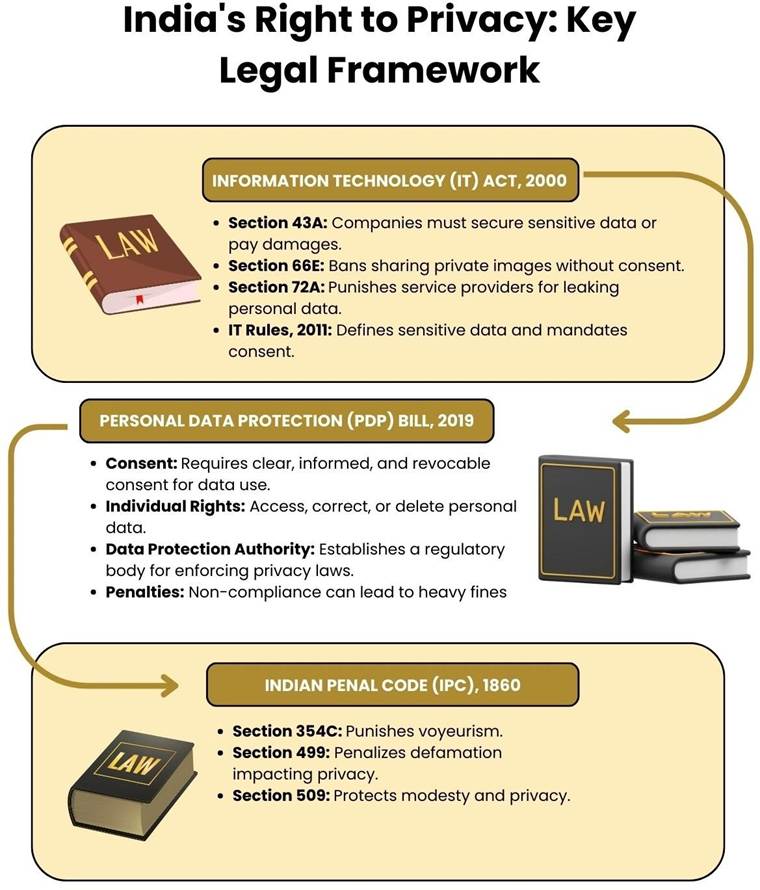
- Implementation of DPDP Act and cross-border data flows.
- Facial recognition, AI surveillance, and algorithmic decision-making.
- Data breaches and lack of remedies.
- Surveillance reform and oversight mechanisms.
- Right to be forgotten and reputational harm online.
“Final Thoughts”:—
- The focus has moved from “does privacy exist?” to “how far does it extend, and when can it be restricted?”.
- The trajectory shows a shift from a state-centric view to an individual-centric one, aligning Indian law with Art 12 UDHR and Art 17 ICCPR.
Justice Dhananjaya Yeshwant Chandrachud wrote:“Privacy is the constitutional core of human dignity.It is the ultimate expression of the sanctity of the individual.”
References
1 Universal LexisNexis The Constitution of India Bare Act with Short Notes 2025 Article 21 Comments (iii) and (vi) Page 14A and 14B.
2Prof. Rajendra Singh (Rajju Bhaiya) University A-1 Notes B.A.LL.B.-2nd Semester (Paper-1) English-2 Page 93.
